
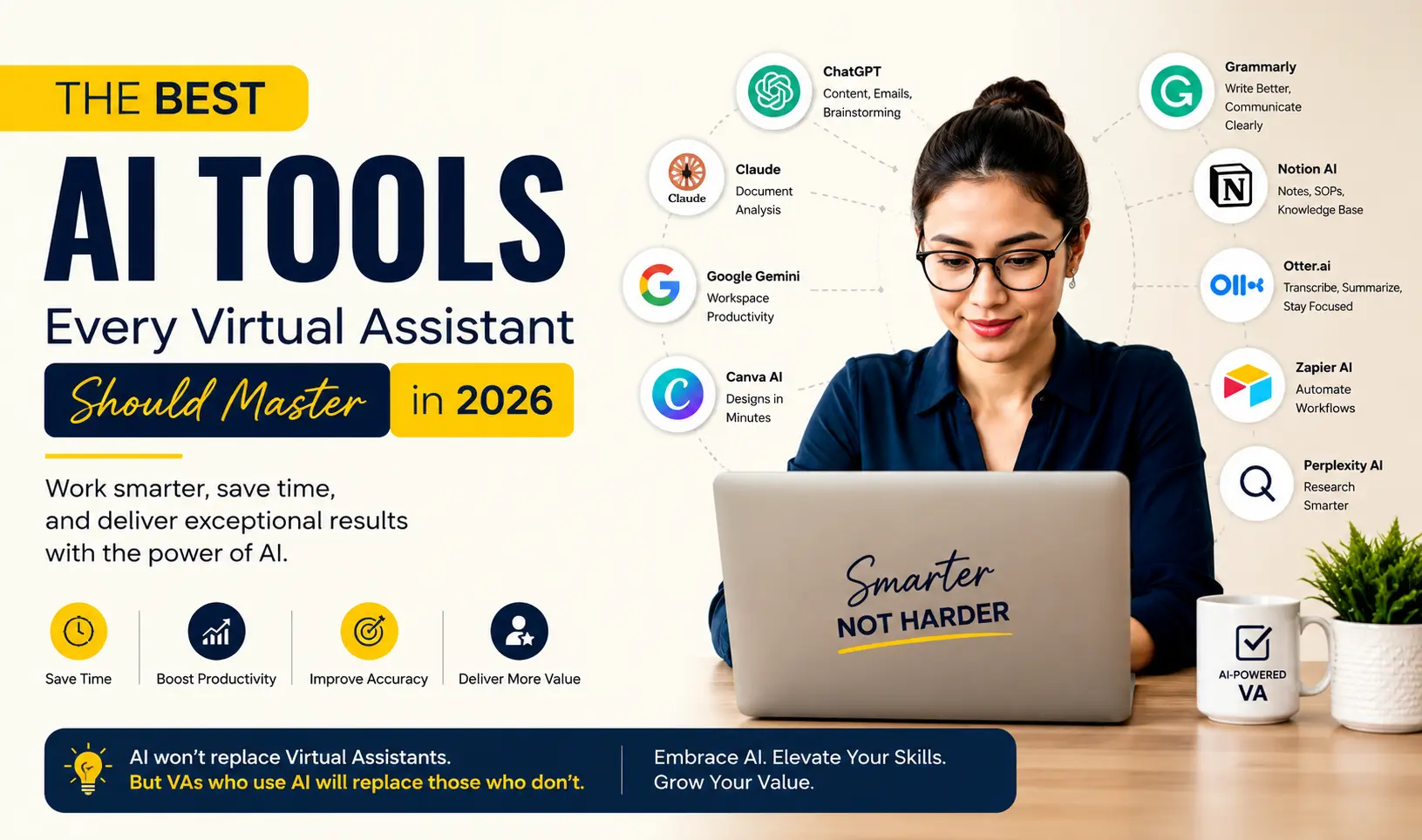
Artificial intelligence is no longer a luxury for businesses. It’s becoming part of everyday operations, helping companies complete tasks faster while improving accuracy and productivity.
For virtual assistants, this shift presents an incredible opportunity. Rather than fearing AI, successful VAs are embracing it as a productivity partner. The right combination of tools allows one assistant to accomplish what previously required several hours of manual work.
Here are the AI tools every modern virtual assistant should consider mastering.
ChatGPT
ChatGPT has become one of the most versatile productivity tools available.
A skilled virtual assistant can use it to draft professional emails, summarize meetings, create social media captions, write blog outlines, brainstorm marketing ideas, generate customer support responses, and simplify complex documents.
The key is understanding that ChatGPT works best when guided by clear prompts and human oversight. It speeds up the process, but the final quality still depends on the person using it.
Claude
Claude is particularly useful when working with lengthy documents.
Virtual assistants often manage contracts, standard operating procedures, research reports, meeting transcripts, and company documentation. Claude excels at reading, organizing, and summarizing large amounts of information while maintaining context.
For administrative support, it’s an excellent companion.
Google Gemini
Businesses that rely heavily on Google Workspace can benefit from Gemini.
It integrates smoothly with Gmail, Google Docs, Google Sheets, and Google Drive, making it easier to organize emails, generate reports, analyze spreadsheets, and collaborate with clients.
For virtual assistants managing multiple Google accounts, this can significantly reduce administrative workload.
Canva AI
Creating professional graphics used to require advanced design skills.
Today, Canva’s AI features allow virtual assistants to create presentations, social media graphics, marketing materials, thumbnails, and promotional content much faster than before.
While good design principles still matter, AI eliminates much of the repetitive work.
Grammarly
Professional communication remains one of the most important responsibilities of a virtual assistant.
Grammarly helps improve grammar, punctuation, sentence structure, and tone across emails, reports, proposals, and client communications.
Small improvements in writing often make a big difference in how businesses are perceived.
Notion AI
Many businesses now rely on Notion for internal documentation.
Notion AI helps virtual assistants organize company knowledge, generate meeting notes, create task summaries, write SOPs, and maintain internal documentation that keeps teams aligned.
It transforms scattered information into searchable knowledge.
Otter.ai
Taking meeting notes manually wastes valuable attention.
Otter.ai records conversations, creates transcripts, identifies speakers, and generates summaries automatically. Virtual assistants can then focus on participating in meetings instead of typing every word.
It’s particularly useful for agencies, consultants, and remote teams.
Perplexity AI
Research is a common responsibility for many virtual assistants.
Perplexity AI provides quick, source-backed answers that make researching competitors, industries, software, or market trends significantly faster than traditional search methods.
It helps reduce research time while improving confidence in the information gathered.
Zapier AI
Automation has become one of the most valuable skills a virtual assistant can develop.
Zapier connects thousands of applications together, allowing repetitive tasks to happen automatically.
Imagine receiving a website inquiry that instantly creates a CRM contact, sends a confirmation email, notifies your team in Slack, and schedules a follow-up task. Instead of completing four separate actions, the system handles everything automatically.
Learning basic automation can dramatically increase the value a virtual assistant brings to any business.
Loom AI
Clear communication is essential when working remotely.
Loom allows virtual assistants to record quick video explanations, walkthroughs, tutorials, and updates instead of writing lengthy emails.
Its AI features can generate summaries, titles, and transcripts, making communication even more efficient.
AI Is a Tool, Not a Replacement
One misconception continues to circulate online: that AI will replace virtual assistants.
In reality, businesses don’t hire virtual assistants simply to complete tasks. They hire them to solve problems, communicate with people, manage priorities, and keep operations running smoothly.
AI cannot replace emotional intelligence.
It cannot build client relationships.
It cannot understand business context the way an experienced professional can.
The most successful virtual assistants in 2026 are not competing against AI. They’re using it to deliver faster, smarter, and higher-quality work.
That’s exactly what clients are looking for.
If you’re hiring a virtual assistant, don’t just ask what software they know. Ask how they use AI to improve productivity while maintaining quality.
If you’re a virtual assistant, investing time in mastering these tools today will make you significantly more valuable tomorrow.